Paul’s insights · AI & search
- AI search
- SEO strategy
- SEO
- GEO
GEO vs SEO: where GEO actually fits
- Last updated
- Reading time
- 5 min read
By Paul Gordon — British freelance SEO consultant, 18 years in search. Written October 2026.
There's been a lot of discussion about GEO and whether it's replacing SEO, something completely different, or just another label for work we're already doing.
My view is that it sits within search marketing. It's part of the overall work. I don't think we should dismiss it, but I don't see it as a separate discipline that suddenly makes SEO less relevant. The skills and experience you've built in search marketing carry straight into this.
Just to be clear about the terms: SEO is about helping your business get found and chosen through search engines. AEO, or answer engine optimisation, focuses on appearing in answers, including featured snippets, voice results and AI answers. GEO, or generative engine optimisation, is about how your business appears and is represented in responses from platforms such as ChatGPT, Perplexity and Google's AI Overviews and AI Mode.
There's a lot of overlap. A technically sound website, useful content, authority and a good reputation all matter across this work. I've covered those foundations in more detail in How AI is Changing SEO.
Where I disagree with the GEO pitch
The bit I struggle with is the idea that someone is now a GEO expert and SEO can be forgotten about.
If a business still has problems with its website, weak content or very little visibility in its market, those things still need addressing. Calling the service something different doesn't remove that work.
After 18 years in search, I've seen the work change considerably. This is another change we need to understand and work with. But there's no doubt in my mind that a good grounding in SEO is relevant to doing it properly.
It depends on the business
There is a difference, though, when you're talking about a large, established brand.
If you've got a Fortune 500 business with years of investment in SEO behind it, then having someone focus specifically on generative AI visibility makes sense. The business has the foundations, the budget and potentially enough activity to justify that attention.
For a local plumber, the priorities are going to be very different. I'd still be looking at the website, local visibility, reviews and whether they're getting enquiries.
That's how SEO has always worked. Different businesses need different levels of support. Their budget, sector and what they've already done all affect where you spend the time. GEO is part of that decision.
What people told me in the survey
Since May this year, with permission from several of my clients, I've been running surveys across their audiences. So far, we've had 3,400 replies across e-commerce, services and SaaS.
The question was:
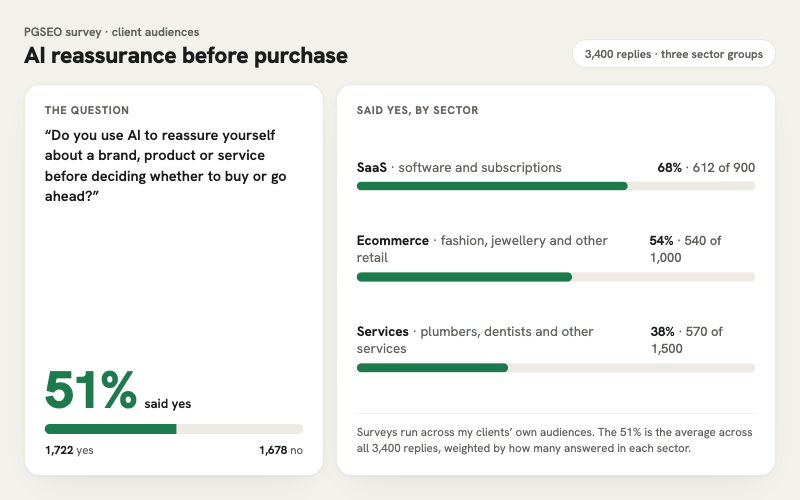
"Do you use AI to reassure yourself about a brand, product or service before deciding whether to buy or go ahead?"
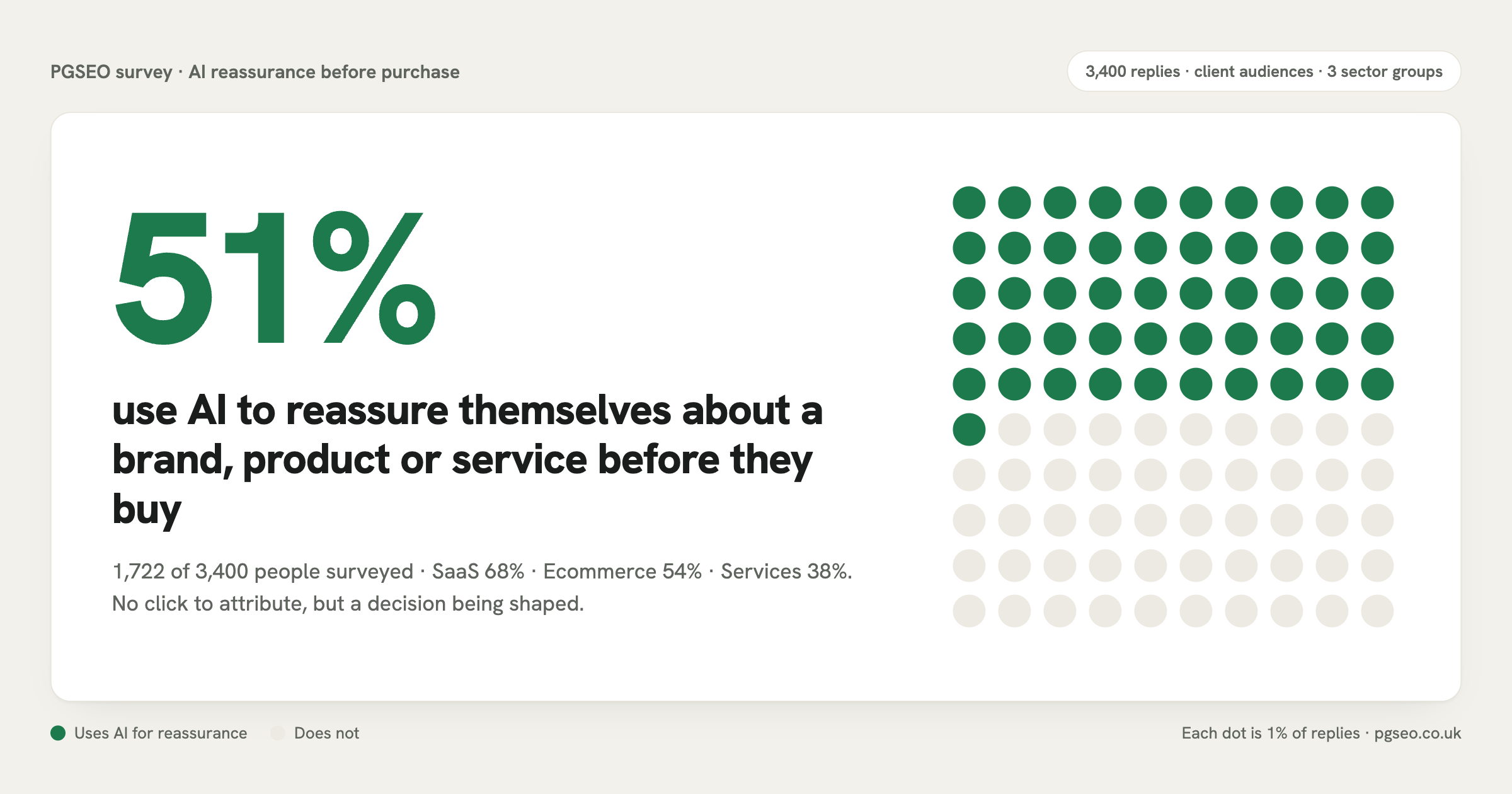
Around 51% said yes — 1,722 people out of 3,400.
When we broke that down by sector, there was quite a difference:
- SaaS — software and subscriptions: 68%, or 612 of 900.
- E-commerce — fashion, jewellery and other retail: 54%, or 540 of 1,000.
- Services — plumbers, dentists and other services: 38%, or 570 of 1,500.
I think urgency could explain some of that difference. If your boiler has stopped working or you need an emergency dentist, you're probably more concerned with finding someone available. With software, a subscription or a purchase you've been considering for a while, there's more opportunity to check things before committing.
That doesn't explain every purchase in those sectors, and the survey didn't ask people why. But it's something I'd like to explore as we collect more responses.
What interests me is the reassurance part. Someone may already know about your business and then use AI to check whether they feel comfortable going ahead. They're asking about your reputation, the product or whether the service is right for them.
That could influence the decision without producing a visit to your website that you can easily identify.
I want to be clear about the limits of this. These are responses from my clients' audiences, not a national panel. It's an initial survey, and I'll keep collecting data. I wouldn't use it to make a claim about every buyer, but it gives us something useful to investigate.
Alongside that, in some of the accounts I work on, I'm seeing direct traffic increase, organic clicks fall and commercial outcomes hold up. That doesn't prove AI is responsible, but it does raise questions about how people are finding and checking businesses. I've discussed that attribution issue in How AI is Changing SEO.
Where I see GEO fitting
I expect this to become a normal part of the SEO service, with the amount of attention it gets depending on the business.
For some clients, it will justify a dedicated piece of work. For others, it will sit within the work we're already doing on their content, reviews, reputation and the accuracy of information about them online.
We should be looking at how businesses appear in AI responses and measuring what we reasonably can. I just don't think we need to treat that as a reason to move away from SEO.
I also think we're going to see more of a gap in the opportunities available to different businesses as search develops. How strong your brand already is, and how much you can invest in marketing, could have a bigger bearing on where you get seen in AI answers.
An established brand may already have years of coverage, reviews and people talking about it. A business with a substantial marketing budget has more scope to build that presence. If you're a smaller business trying to establish yourself, you're starting from a different position.
Brand and budget have always played a part in search. What I think could change is how much that existing presence matters when AI is deciding which businesses to bring into an answer or recommendation. I honestly believe that's where some of the gap will develop.
That doesn't mean smaller businesses won't have opportunities. A business can be very well known within its particular market without having a huge budget. But I do think the opportunities, and the work needed to get into them, will look different depending on the business. That's another reason I wouldn't approach GEO in the same way for every client.
I'll update this page as the survey grows.
If you'd like to understand how your business appears in AI responses and where that fits into your search marketing, get in touch.