Paul’s insights · AI & search
- SEO
- AI & search
- Measurement
How AI is Changing SEO

- Last updated
- Reading time
- 16 min read
By Paul Gordon — British freelance SEO consultant, 18 years in search. Written October 2026. I'll update this page as the data changes.
Good SEO is the foundation of good AI SEO
Two questions keep coming up in conversations with clients: "Why is organic traffic down year on year?" and "Why is direct traffic going up?" In some of those accounts, sales and enquiries are actually up. So commercially, things are moving in the right direction, but the traffic reports don't make it obvious where that growth is coming from.
Part of the difficulty is attribution. Someone might discover your business through an AI answer, click through to the website, or come back later and search for your brand. We can track some of that, but we don't always see where the journey started. Some visits may end up recorded as direct when the source information is missing. That doesn't mean AI explains every increase in direct traffic, but it does mean we need to look further before treating a drop in organic traffic as a drop in the value of the work.
Rather than talk about that in the abstract, here's a live example — the same e-commerce account you'll see in the citation charts further down, each figure against the same period last year and labelled with the window it comes from:
- Google organic clicks (Search Console, whole site, 90 days): 4,309 — down 54.6% from 9,493.
- GA4 organic sessions (90 days, excluding the blog): 20,492 — up 1% on last year.
- Rankings (735-keyword desktop comparison set): 621 keywords on page one, against 701 last year. The top-three count level at 548.
- Direct (28 days): 7,931 sessions against 3,817 — more than double.
- The main order-conversion event recorded in GA4, all channels: 908 → 1,661 year on year. Organic accounted for 328 of those, up from 230. And GA4's new AI Assistant channel — which didn't exist in last year's data — recorded 25.
- Organic revenue won't settle on one story: down 22% on the 90-day view (£78,430), up 12% on the 28-day view, up 90% across the last seven days.
Those figures raise different questions. Google clicks are down sharply, the top-three keyword count is unchanged, and direct sessions and the recorded order conversion are up. Organic revenue also looks stronger over the shorter windows than it does across 90 days. Before drawing a conclusion, I need to check the reporting periods and definitions, then understand which parts of the business are improving and where we're losing traffic. And this isn't unique to one account — I'm seeing the same shape across other clients I work on.
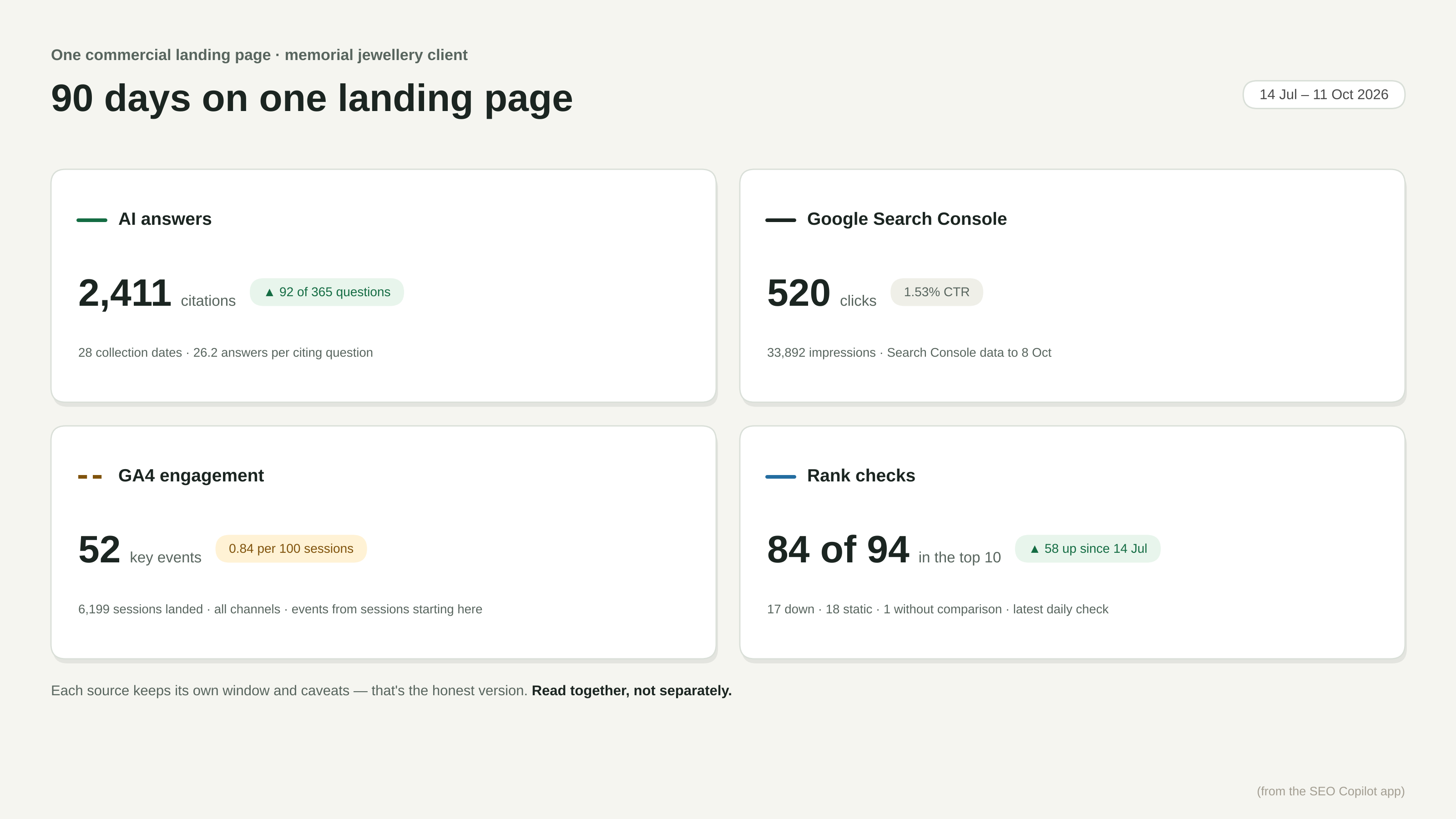
The way I approach this is to take an important landing page and look at the data together. How often does it appear in the AI answers we track? What are the impressions and clicks telling us in Search Console? How much traffic is landing on it in GA4, how engaged are those visitors, and are those visits leading to enquiries or sales? Alongside that, I look at which tracked keywords have improved, dropped or stayed the same over the period.
There are gaps in that data, particularly when it comes to understanding the full journey to a conversion. But looking at it together gives me a much better basis for explaining what's happening and deciding what needs attention. Here's an example from one client: a commercial landing page viewed over 90 days.
After eighteen years in SEO, my view is that good SEO is still the foundation. You'll hear terms like AI SEO, GEO and AEO. They don't all mean exactly the same thing: AI SEO is a broad term, GEO focuses on visibility in generative AI responses, and AEO focuses on having your content surfaced as an answer, including through features such as featured snippets and voice search. There's overlap, and people don't always use the terms consistently, but many of the foundations are shared: a technically sound website, useful content, authority within your market and a good reputation.
AI has widened what we need to pay attention to. How does it describe your business? Which sources does it use? What do your reviews, videos and other websites say about you? These all matter when we're trying to understand how potential customers discover and assess a business. For me, that means collecting more relevant data and using AI within my own systems to help analyse it and decide where to focus the work.
I was already discussing these changes with clients during 2025. By the start of this year, it was becoming a much bigger part of both the work and the conversations around performance. There are still questions I can't give a definite answer to, and I see experienced SEOs and agencies working through the same issues. What I can share is what I'm seeing across my own clients, what the data supports and how it's changing the decisions I make.
The biggest change is how we measure
A lot of SEO conversations still start with a keyword. A client wants to be on page one, or number one, and that's what they judge the work against. I understand why: it's something they can see and compare. But a position on its own doesn't tell us whether the work is bringing in the right visitors or generating business. That's always mattered. The changes in search make it even more important to explain it properly.
For most of my clients, that conversation has mainly been about Google. What I try to bring it back to is what they want commercially: more enquiries, sales and revenue. Rankings help us assess progress, but if those improve and sales don't, we need to understand why.
For the last few years, I've been looking more broadly at how people search. That includes Google and Bing, features such as AI Overviews and AI Mode, and AI assistants such as ChatGPT and Perplexity. The way people find and compare businesses now spans several of these places.
One difference with AI answers is how much they can vary between questions, platforms and runs. We can measure how often a business appears in the answers we collect, but that is a result from our sample. It isn't a fixed position or a measure of how often every potential customer sees the business. Even traditional rankings vary by location, device and time, so the conditions behind the numbers matter.
If your reporting still revolves around a keyword export, it will leave some important questions unanswered. Rankings remain useful. They just need to sit alongside the other information that helps explain performance.
What I'm seeing with AI Overviews
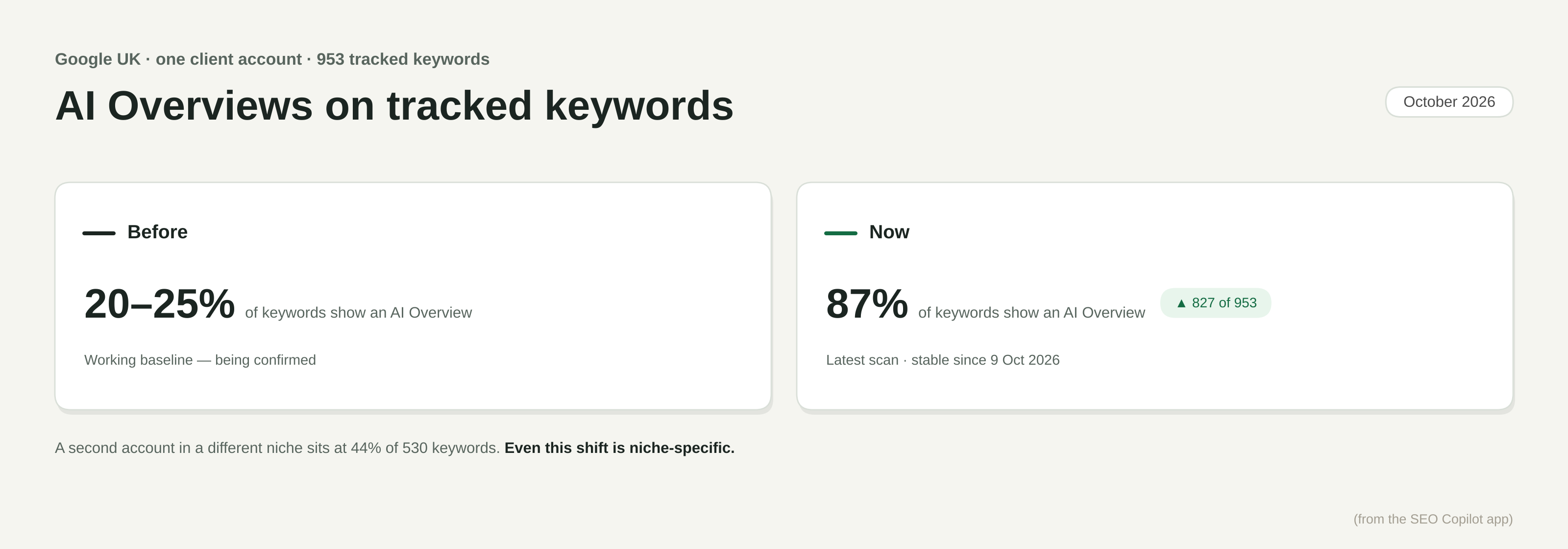
In early October 2026, I've seen a substantial increase in AI Overviews on one of the UK accounts I track. In the latest Semrush scan pulled into SEO Copilot, an Overview appeared for 827 of 953 keywords: 87%. From what I'd been seeing, the previous level was around 20–25%, although I still need to confirm that baseline and the exact timing against the historical scans. A second account, in a different niche, showed Overviews for 235 of 530 keywords: 44%. These are two client keyword sets, so I wouldn't treat either as a measure of Google UK overall.
That's a significant change in the results those clients are competing in. An organic position alone doesn't show us what else is appearing around it or how that affects the decision to click. On the first account, the client was cited for 524 of the 827 keywords where an Overview appeared: 63%. That gives us another useful measure of visibility, although it doesn't tell us how many people saw those citations or clicked through.
I've also been encouraging clients to look closely at how their business is represented online: their reviews, business profiles and what comes back when someone searches for them. We're now seeing AI Overviews on some branded searches too. An AI-generated description can become part of a customer's first impression of the business, and negative or inaccurate information may feature in it.
On one account, Trustpilot domains appeared 3,077 times in the AI answers we monitored over 90 days. That tells me review platforms deserve attention within that tracked question set. It doesn't prove that a higher review score causes more AI citations. The practical work is still to earn honest reviews, deal with problems and keep information about the business accurate.
The job now: more data, and AI inside your systems
Doing SEO properly involves costs beyond the time spent making changes. There's research, crawling, tracking and reporting, and monitoring AI answers adds to that. The important thing is understanding where the data comes from and what it can tell you. Paying for a tool doesn't automatically make its data reliable, and free sources such as Search Console and GA4 are central to the work.
Take a client on £1,000 a month. They may rely on you to spot technical problems, notice when conversion tracking breaks and explain why enquiries have changed, as well as carry out the agreed SEO work. You have to prioritise carefully. Collecting the right information helps you decide where that limited time will make the most difference.
AI has made it more practical for me to build tools around that work. There are still development, data and maintenance costs, and those need to be accounted for. If additional monitoring means a higher fee, the client needs to understand what it will help us decide and why it's worth doing.
It also helps with the day-to-day workflow. I can bring together information from Search Console, GA4, Semrush, Screaming Frog and the tools we use to manage the work, then use AI to help review it and identify things that need a closer look. I still need to check the findings, but it means less time moving between reports and more time deciding what to do.
A few years ago, a proper report could take me several days. I can now put together a more detailed review in about half that time, covering work I wouldn't previously have had time for. AI helps with that analysis, but the value to the client comes from the decisions and actions that follow.
For over a year, I've been building SEO Copilot to bring this information together for my clients and me. The aim is to see what's working, identify issues earlier and find opportunities across organic search, AI visibility and the wider marketing activity.
That changes what I want the report to do. It should help the client understand the position and the next steps, including where the evidence is incomplete.
What my own tracking shows
I'm not an AI engineer. My background is in paid and organic search, development and eighteen years of SEO. I'm approaching AI visibility in the same way I've approached other changes in search: collect the evidence, look at what changes and test what seems worth acting on.
I've been monitoring the answers these systems produce across several client sectors. I'm interested in whether improvements to content, technical SEO and brand reputation are followed by changes in the answers we track. In some accounts, I'm seeing those things move together. That is useful to investigate, but it doesn't establish that my changes caused the movement.
The reason I collect this myself is to understand what applies to each client. There is useful research being shared, but a finding from one market or question set may not apply to another.
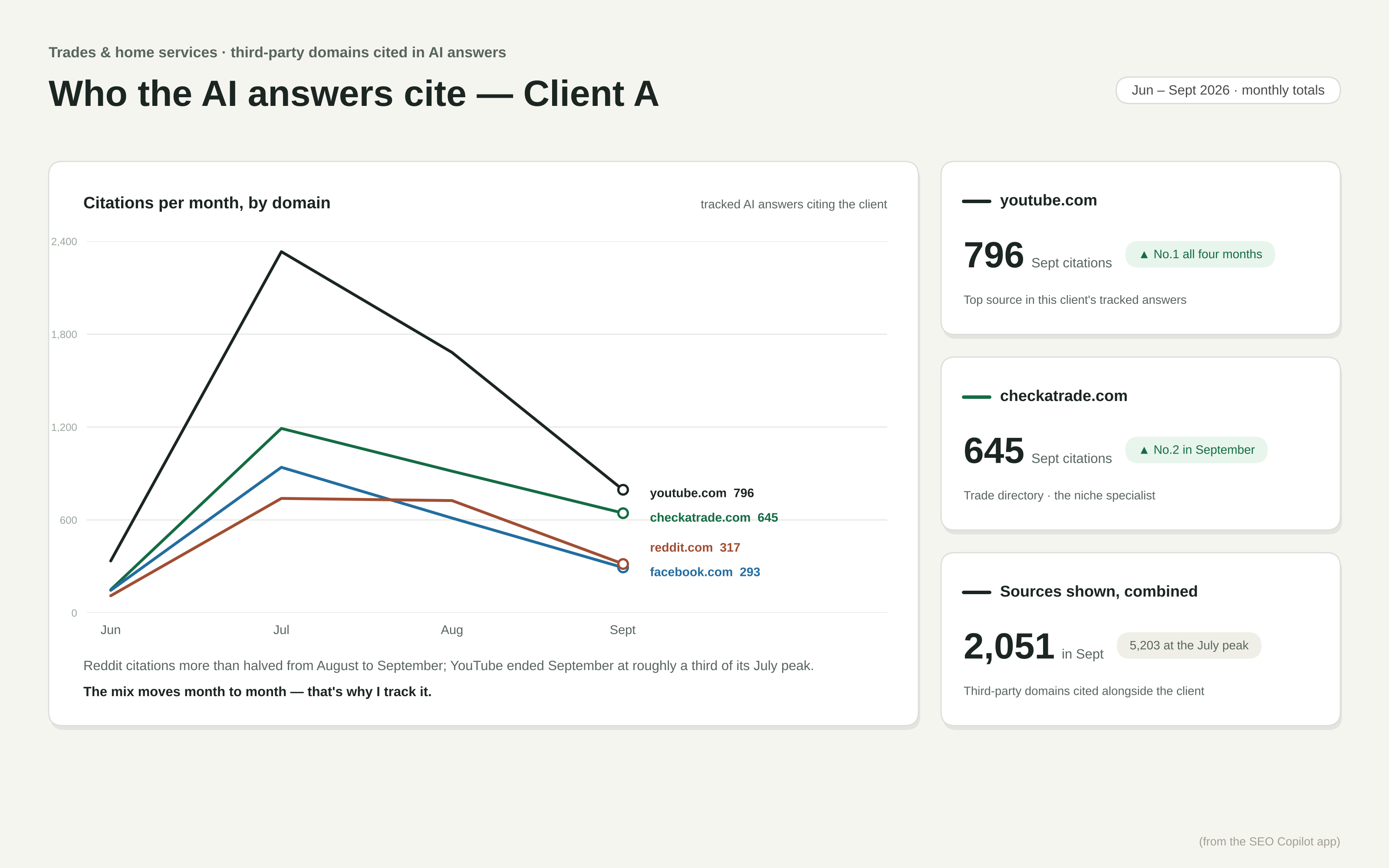
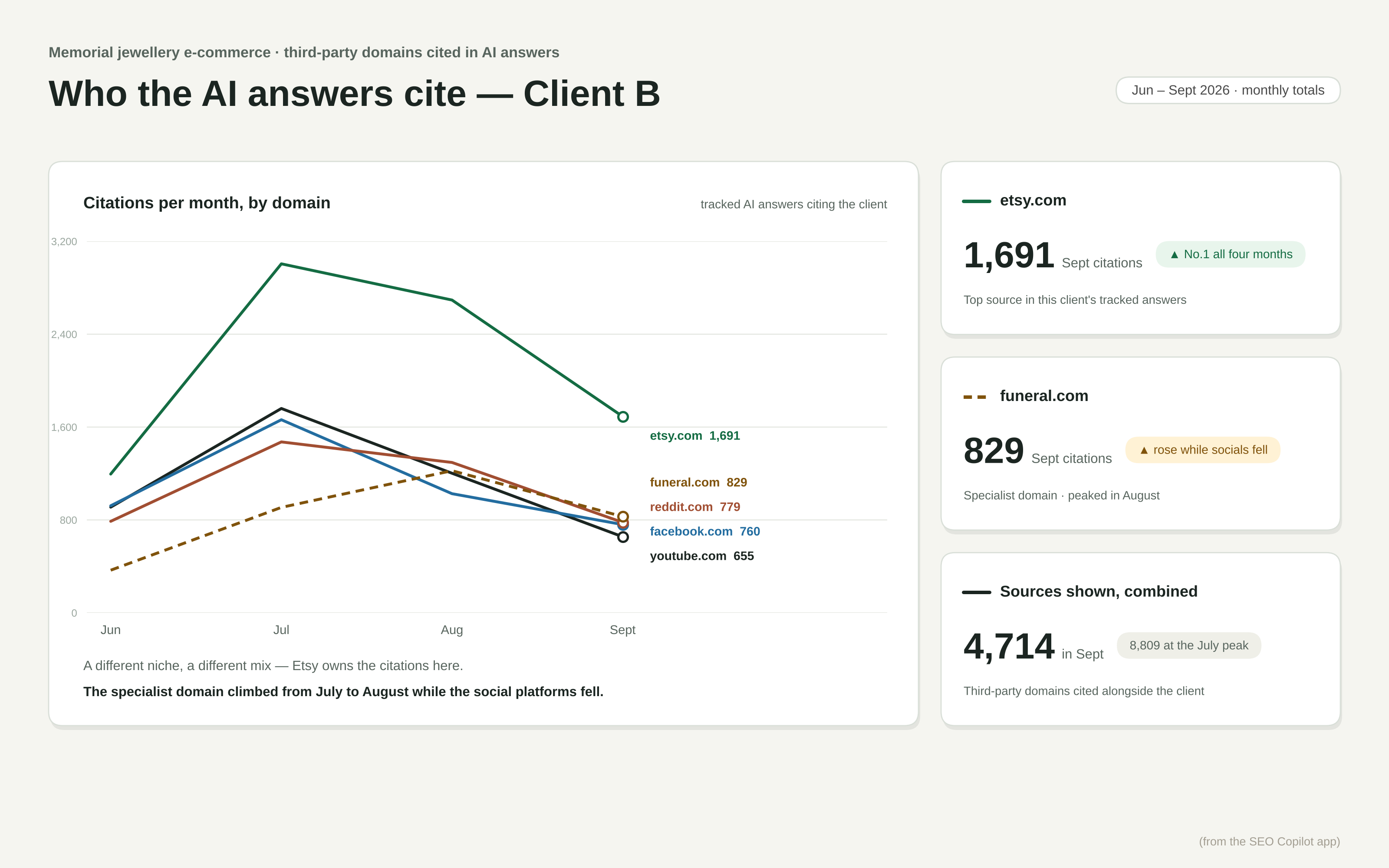
The two charts below show the third-party domains cited in the answers we monitor for two clients. YouTube is the most frequently cited of the domains shown for the trades and home services client. For the memorial jewellery client, Etsy leads. That's useful when deciding which sources to investigate for each business, although the results also depend on our questions and the AI platforms we're monitoring.
The recorded counts also change substantially between months. June was the first month of tracking and may be incomplete, so I would focus on July to September. For the trades client, Reddit citations fell from 725 in August to 317 in September. For the memorial jewellery client, Etsy fell from 3,006 in July to 1,691 in September, a drop of about 44%.
The specialist site funeral.com followed a different pattern: 908 citations in July, 1,224 in August and 829 in September. It rose from July to August while the social platforms shown declined, then fell in September too. Before treating any of these movements as a change in citation likelihood, we need to check that the questions, providers and completed runs were comparable. Raw counts alone don't settle that.
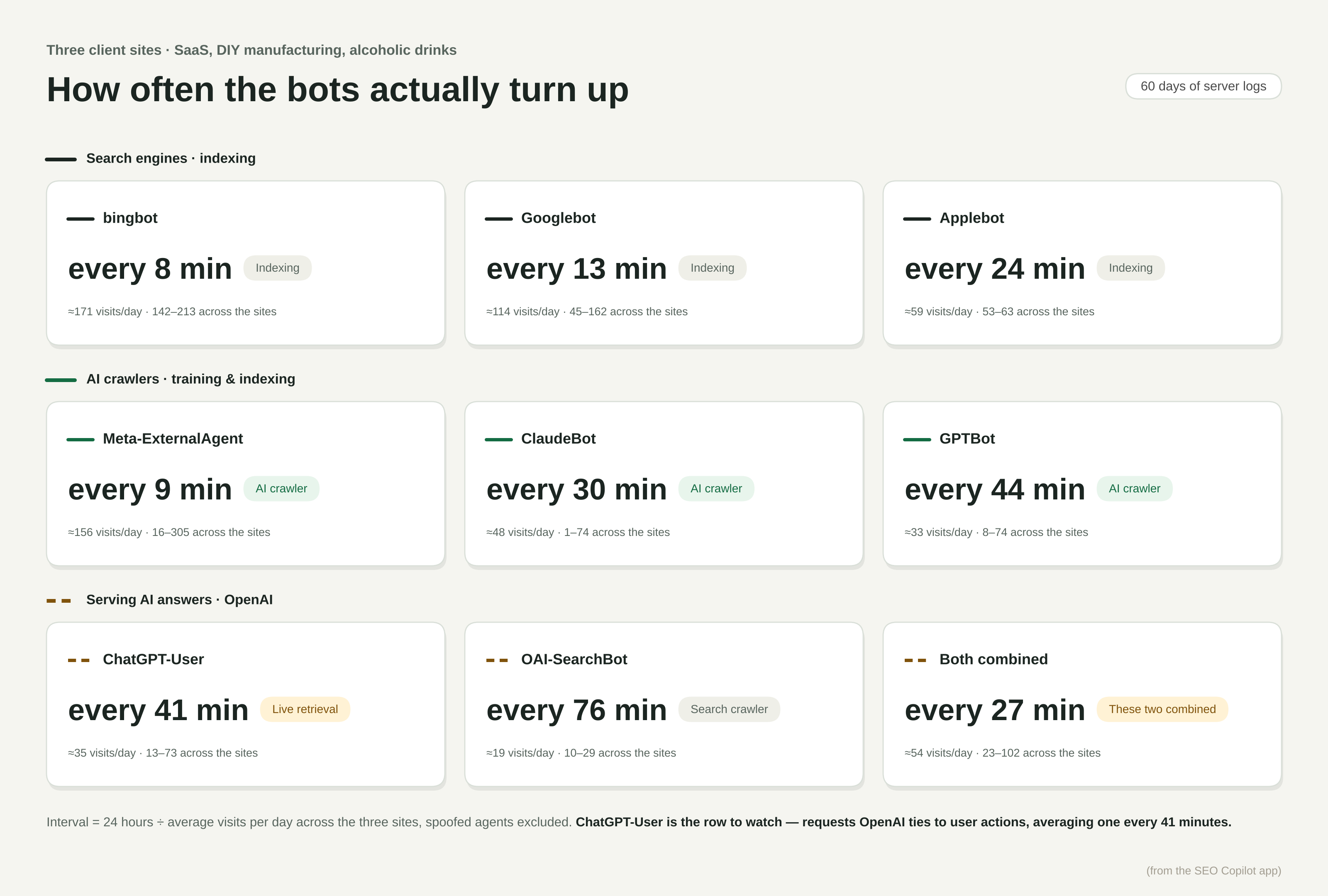
Where possible, I've also been collecting server-log data to understand how often AI bots request pages from client sites. The example below covers 60-day windows for three sites: SaaS, DIY manufacturing and alcoholic drinks.
Across those sites, Meta's AI crawler averaged about 156 requests per day per site, compared with about 114 for Googlebot. That is equivalent to one request every nine minutes and thirteen minutes respectively. On one site, GPTBot and ClaudeBot each averaged roughly one request every nineteen minutes. These are averages calculated from request counts; the requests may arrive in bursts.
ChatGPT-User needs to be considered separately. OpenAI describes it as handling certain user-initiated actions, rather than automatic web crawling. In this sample it averaged about 35 requests per day per site, equivalent to one every 41 minutes. On the drinks site, the equivalent was about one every twenty minutes. OAI-SearchBot is used for search crawling, while GPTBot collects content that may be used for training.
This helps us understand access to the sites. It doesn't tell us how many unique people were involved, whether the pages were cited in an answer or whether any enquiries followed. I'm continuing to review the bot classifications and verification before publishing a fuller breakdown.
There is wider research on this too. Cloudflare separates AI bot traffic by purpose, including user action. Fastly's Q2 2025 research attributed 98% of its observed fetcher requests to OpenAI's bots and 52% of its observed AI crawler traffic to Meta. TollBit's Q3–Q4 2025 report found that average scrapes per page by RAG bots were roughly ten times those by training bots in Q4. Those findings use their own datasets and bot categories. My examples add a view from three client sites.
One thing that stood out in the logs was that some requests using AI bot names targeted credential files. I excluded that suspicious traffic. A user-agent name alone doesn't verify the sender, though, so filtering those paths isn't enough to prove all the remaining requests are genuine. Where available, published IP ranges or other provider verification methods are needed.
Here's another example from one commercial landing page, bringing together rankings, monitored AI citations, Search Console and GA4. The dashboard covers 2 September to 2 October 2026, although the Search Console figures only run to 29 September.
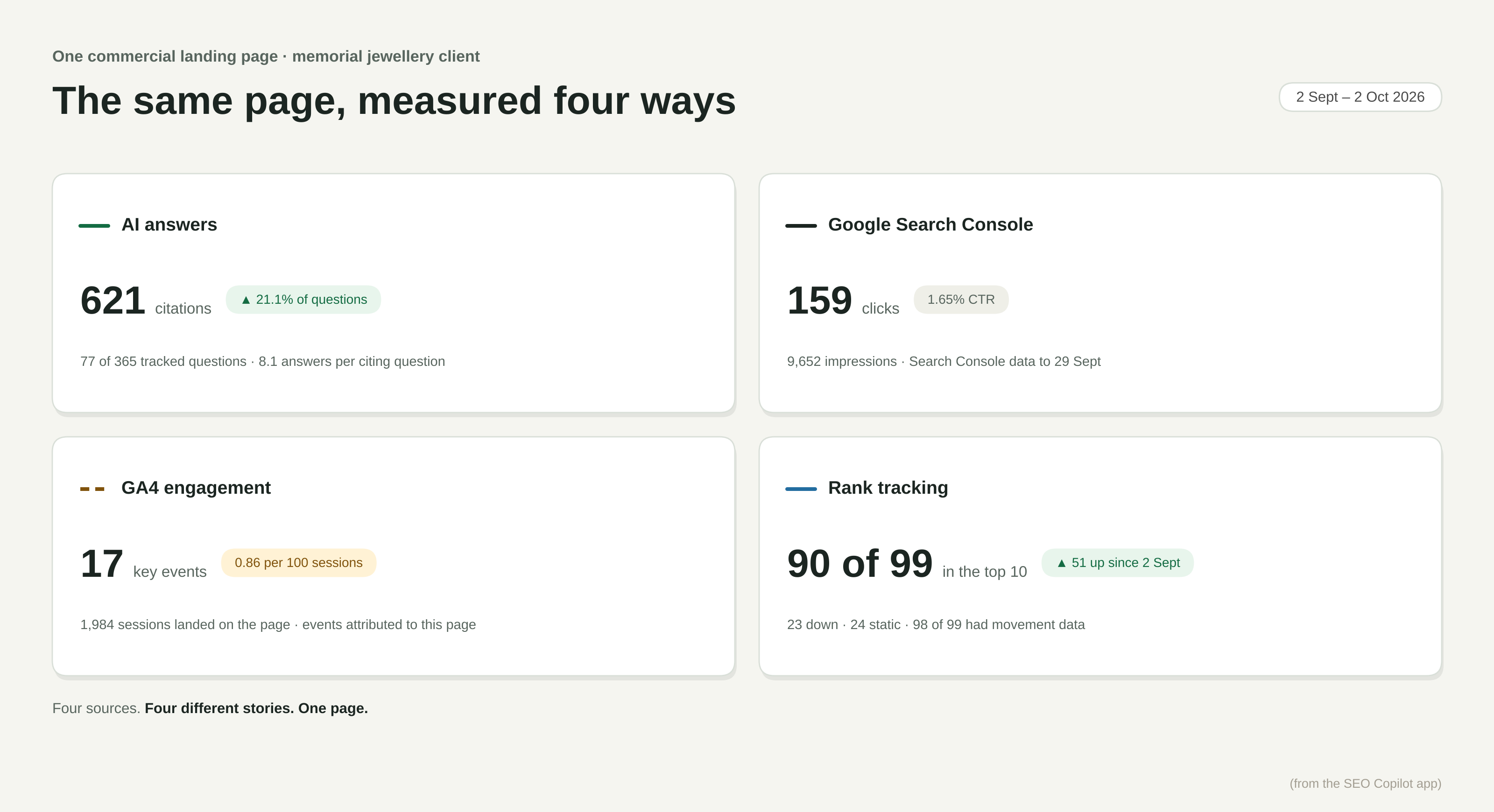
Ninety of the ninety-nine tracked keywords for this page were in the top ten. Search Console recorded 9,652 impressions and 159 clicks, a CTR of 1.65%. Our monitoring recorded 621 citations across repeated answers, covering 77 of the client's 365 tracked questions. GA4 showed 1,984 sessions landing on the page and 17 key events attributed to it.
Those figures measure different things. The citations come from our monitored sample, the Search Console clicks come from Google Search, and the GA4 figures need their channel and attribution settings taken into account. They don't prove that AI visibility generated the key events. Together, though, they give us better questions to investigate than the rankings alone.
This is why I think an SEO needs a working understanding of conversion rate optimisation, tracking and the client's market. If visitors arrive but don't enquire or buy, we need to investigate that with the client and whoever manages the website.
It also means working more closely with whoever manages paid search and the other channels. A customer may discover a business in one place and return through another. Sometimes we can see that connection; often we can't. Looking at the channels together helps us investigate without assuming that every increase elsewhere came from SEO.
The point of bringing this together is to make better decisions about what to fix, where to invest and what to measure next.
The client conversation
Clients need to understand what we're measuring and how it relates to their business.
I was discussing these changes with clients through 2025, including the need to spend time collecting information before we could draw useful conclusions. Those conversations need to continue as the results change. If traffic falls, showing that a keyword is still number one won't answer the client's concern. We need to explain what we know, what we don't and what we're doing next.
I lost a few clients during this period. My impression is that, for at least one, uncertainty about the changes and the time being spent on preparation played a part. I can't speak for their full reasoning. But it reminded me that I need to explain why I'm collecting this information and how it will help the business, rather than expect the client to see the value automatically.
Rankings, citations and traffic help us assess progress. The commercial question is whether the work is helping generate worthwhile enquiries and sales. We should have been asking that before AI became part of the conversation.
If a client wants to be number one for a particular keyword, I want to understand why that term matters to them. It may be a sensible target. We still need to agree how we'll judge its value once they get there.
The fundamentals haven't moved
The term "entity" comes up a lot in these conversations. In practical terms, some of the work is familiar: keep business information accurate, earn honest reviews, build useful content and establish a presence in the places that matter to your market. Those things were worth doing before AI answers became part of search.
How much you can do depends on the business and its budget. Most of the examples here come from businesses competing nationally or in e-commerce. A small local business may need a different set of priorities.
The questions worth asking now
For any landing page that matters to your business, this is the overview I want:
- Where is it being cited — and what's the citation rate over the last 90-day window?
- What did it do in Search Console — clicks, impressions, which queries?
- How many sessions landed on the page in GA4, from which channels, and what key events were associated with them?
One of the gaps is still understanding how many customer journeys start in an AI assistant. Someone may discover the business there and later return through a brand search. We can't reliably reconstruct every journey, so an increase in brand searches is something to investigate, rather than proof of AI's contribution.
This is where sharing information with the client and the rest of their marketing team helps. We can compare what we're seeing and decide what needs attention.
No gurus here
I don't have a settled answer to every part of this. What I can do is be clear about what I've observed, how I've measured it and where I'm still checking.
SEO has always changed. My responsibility is to keep up with those changes, identify problems and opportunities, and help clients decide where to put their time and budget. Bringing the data together makes that easier, even though attribution remains incomplete.
I still see opportunities for smaller businesses to improve how they appear in search and AI answers. Established brands may have advantages, but that doesn't tell us which business will appear for every question. The useful work is finding the gaps relevant to each client and deciding which ones are worth pursuing.
That works best when the client and I can discuss the results openly, including what's disappointing or uncertain, and agree what to do next.
I'll update this page in a few months with what the next set of data shows.
If you want this kind of view across your own channels, that's what I do.