Website Migration SEO Case Study
An established clothing retailer on Magento Commerce — a capable platform, but an expensive one to run and develop. The business case for moving to Shopify was clear. The risk was everything they'd built in search.
Timeline
Planned and run by me: six weeks of preparation and de-risking, launch in February 2026, then post-launch monitoring against the benchmark for the months that followed.
Why this is the riskiest thing a store can do
A replatform touches everything at once: URLs, templates, internal links, page speed, structured data. Any one of those changing badly can cost rankings. On a migration, they all change on the same day.
Magento to Shopify carries its own specifics. URL structures don't match — Shopify forces its /collections/ and /products/ paths, so almost every URL on the site moves. Faceted and filtered URLs behave differently. Category page content and metadata don't carry across by themselves. Get the mapping wrong and years of accumulated authority points at dead ends.
This site carried years of Magento history with it: a catalogue bloated with out-of-stock products that were never coming back, and ranges and categories sitting live with nothing behind them. Magento Commerce has never been great with variable products either, so there was a proper clean-up to do before anything moved.
And because the URL structure changes regardless when you leave Magento, the migration became the moment to do it properly — prune the products, prune the categories, map everything out, look for new opportunities, and de-risk cannibalisation on the way through.
How I de-risk it
- 1
Benchmark everything first — rankings, traffic, indexed pages, page speed — so there's a baseline nobody can argue with.
- 2
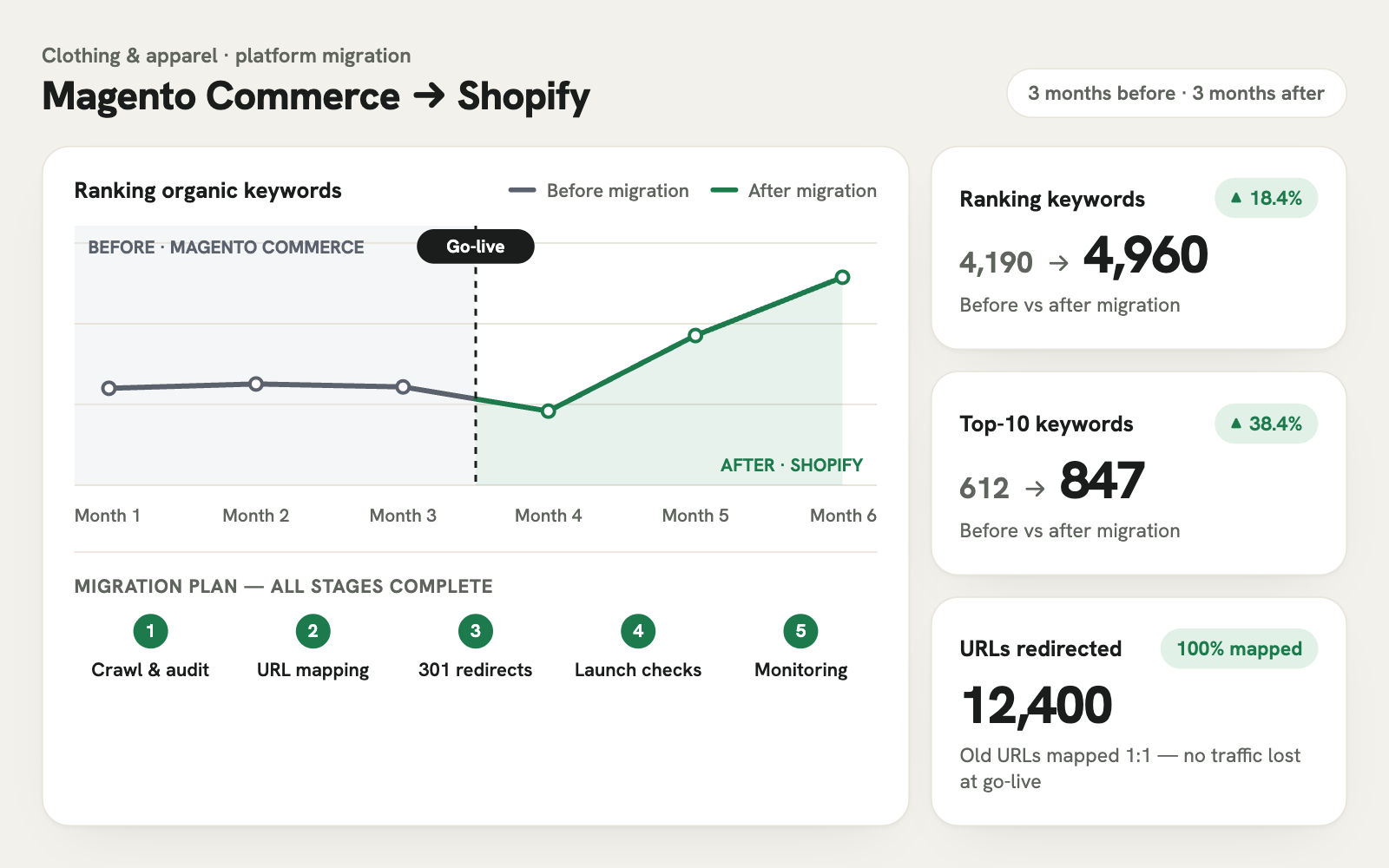
Full URL inventory and redirect mapping — keeping each product's handle identical on the new platform, so every product resolves through one clean redirect pattern instead of thousands of one-off redirects. Individual URLs can still be improved later; launch day stays simple.
- 3
Content and template parity checks — making sure what ranks today exists, in full, on the new platform.
- 4
Launch-day verification: redirects live, indexing open, nothing important blocked.
- 5
Post-launch monitoring against the benchmark until the picture is stable.
The biggest risk on a migration usually isn't the SEO — it's developer timing. The de-risking work needs the build finished early enough to check everything properly, and it rarely is. This one was no different: the final couple of days before launch were a scramble. We got through it — but that's exactly why the checks exist.
The results
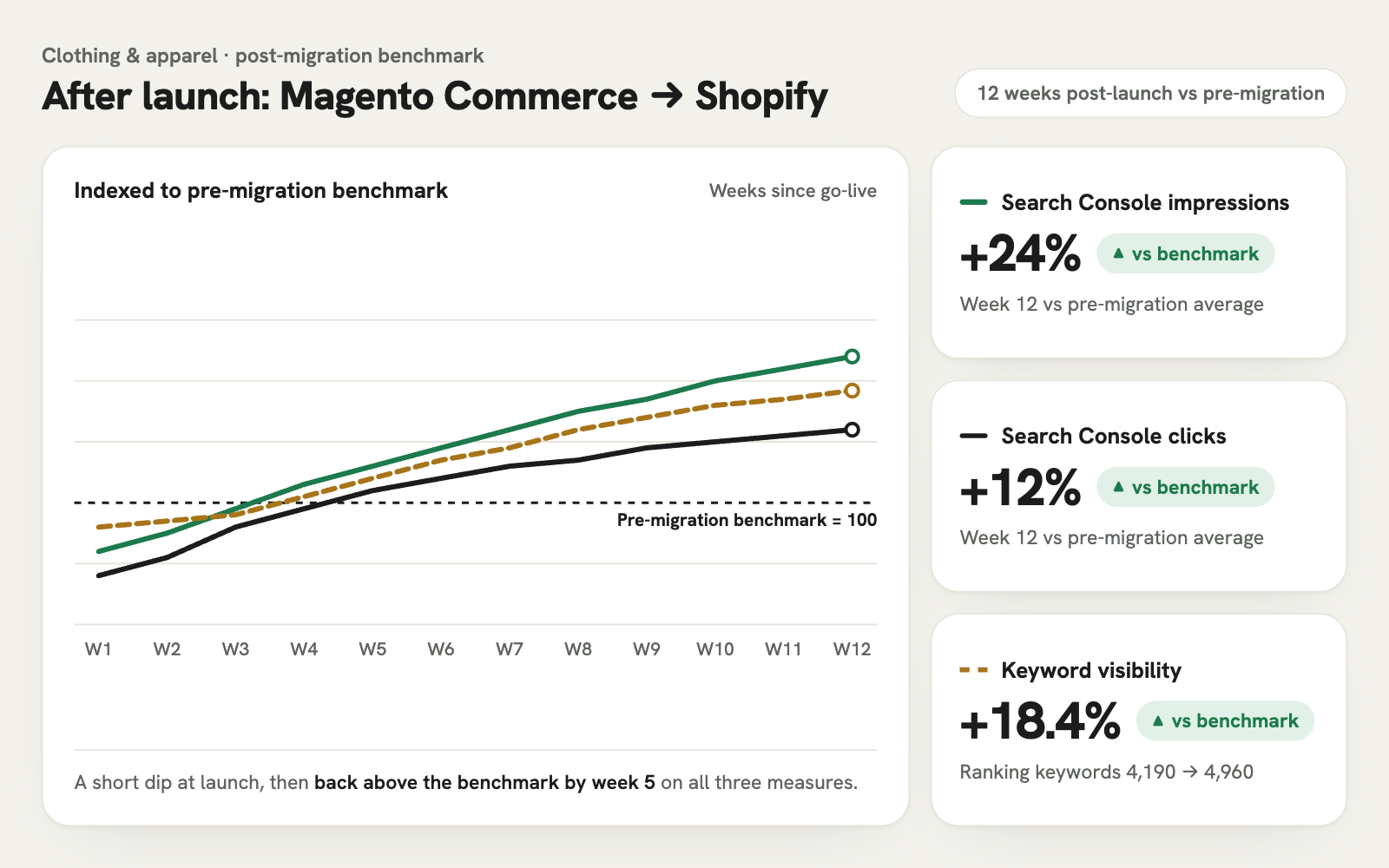
Benchmarked before launch, tracked weekly after it. Back above the pre-migration benchmark by week five. By week twelve: impressions up 24%, clicks up 12%, keyword visibility up 18.4%.